Tap means stop
Hand, foot, or voice: release immediately, every time.
 GavranBJJ Academy
The training agreement
Control submissions, communicate with your partner, and maintain safe behaviour as intensity increases.
Room culture
We do not allow deliberately rough treatment of beginners, humiliation, or exercise as punishment. Instructors explain mistakes and help members correct them.
Training does not require any particular academic or professional background. Partners help each other learn and are responsible for working with control. Hard rounds have a specific training objective. Repeatedly unsafe behaviour is not tolerated. Our aim is for members to develop their athletic ability, protect their joints, and be able to continue training in their sixties and seventies.
Every member is expected to train with control, communicate clearly, and respect their partners.
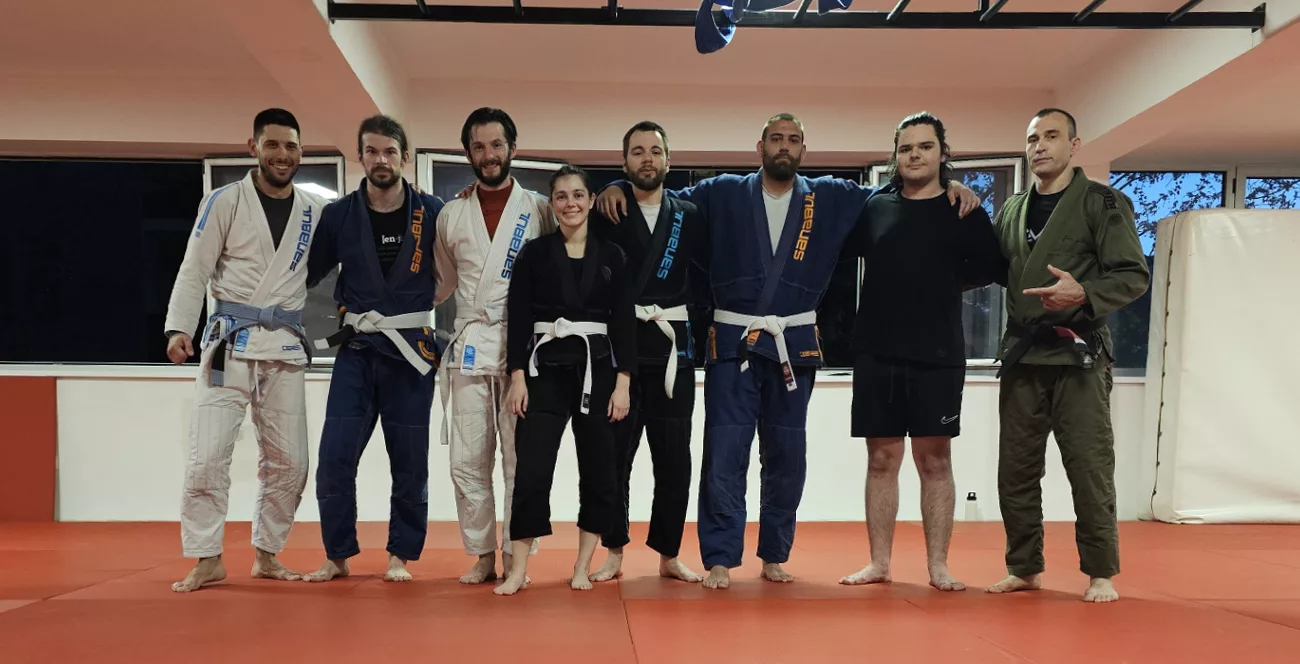
Gavran BJJ / photographs
On the mat, between drills and after competition.
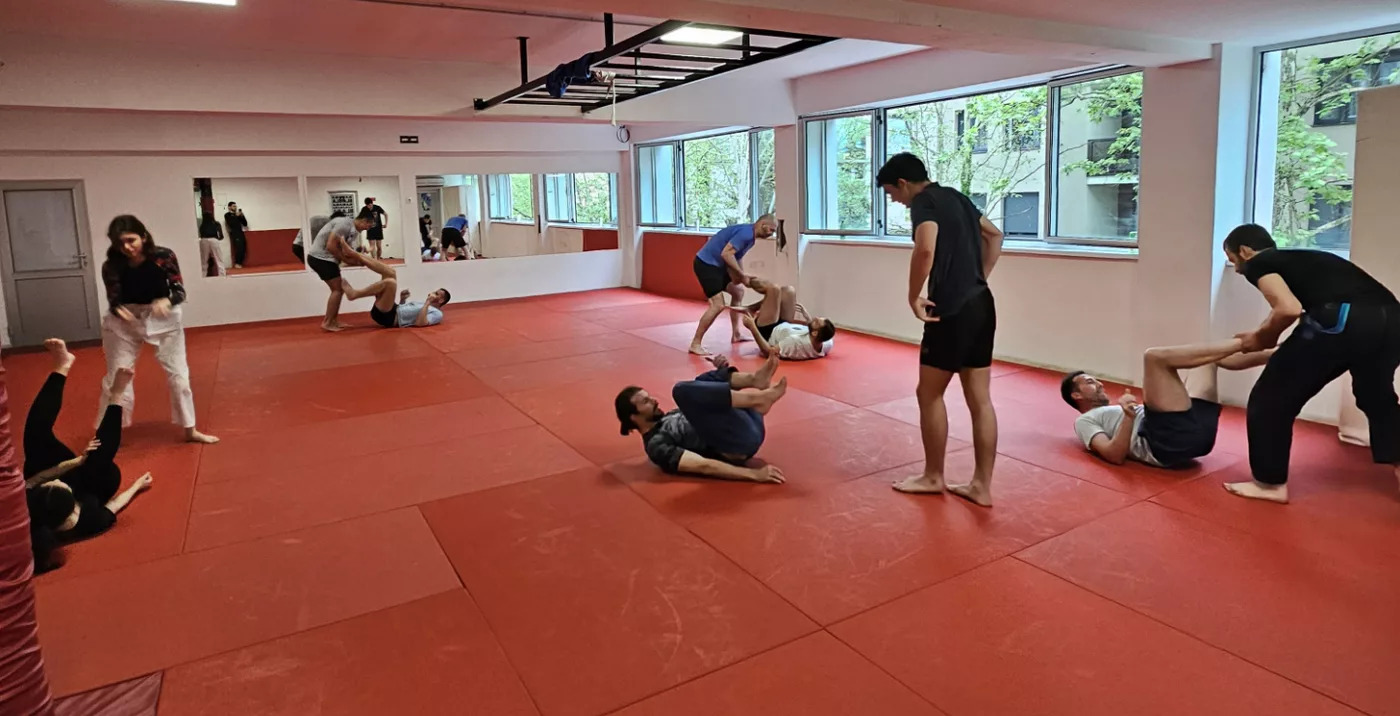
Several pairs, different tasks.
A team photograph with medals.
A pause for a group photograph.
The training agreement
Hand, foot, or voice: release immediately, every time.
Tell the instructor and relevant partners; accept adaptation or sitting out a task.
Clean body, clean kit, covered cuts, short fingernails and toenails.
Contagious conditions and suspicious lesions do not enter the training space.
No rings, watches, chains, piercings, or hard objects on the mat.
Control submissions, calibrate resistance, and protect less experienced partners.
All members are expected to think, communicate, respect their partners, and take responsibility for their actions. Age alone does not determine whether someone meets these expectations.
We do not intimidate beginners, humiliate members, or punish mistakes with exercise. Hard training has a specific learning or preparation objective; exhaustion alone is not the goal.
Formats + intensity
We train gi and no-gi, wrestling, and leg locks. Each session’s format is listed in the timetable. Beginners can wait two or three months before buying a gi.
Heel hooks are mostly blue-belt-and-above work. A white belt needs supervision, composure, control, and explicit permission. Nothing rotational is applied explosively.
A beginner’s first months
Safety, tapping, simple movement, foundational positions or games. Gi not required; sparring follows readiness.
Frames, posture, balance, connection, positional orientation, guided games, and simple technical tasks.
Integrate into the unit at the right level, add resistance gradually, attend broadly, and acquire equipment when it becomes useful.
Develop an individual game, athletic capacity, judgment, and the ability to solve unfamiliar grappling problems.
Competition + rank
You can train indefinitely without competing, and competition is not required for blue belt. Members may also continue training without pursuing promotion.
Competition experience is required beyond blue belt. Competition preparation includes tactical work, harder rounds, shark tanks, and practice under competition conditions. Recreational beginners are not required to take part.
Techniques and concepts required for the belt are tracked over time.
Igor assesses the required material and recommends the member when they meet the requirements.
Professor Đorđe Vasić confirms the standard and awards the belt through Fenix BJJ.
Promotion takes place in Novi Sad or at Gavran during a mentor visit.
Frequently asked questions
No. You are paired and coached for your current experience, size, condition, and composure. Building movement capacity is part of our job. Nobody is required to perform a movement or train at an intensity for which they are not ready.
No. Training gradually develops coordination, conditioning, mobility, and grappling skill. We may recommend additional exercise when it would help, but you do not need to reach a fitness standard before joining.
Not at all. We teach the basic movements and positional vocabulary from the beginning, at a pace you can absorb. Experienced practitioners are equally welcome.
You receive an orientation to tapping, partner safety, basic movement, and a simple position or game. We give you a task that makes sense even if the current group is halfway through a unit.
No. A sparring block concludes regular BJJ sessions, and live resistance is strongly recommended because it develops your ability to apply techniques against an opponent. Your own participation is not forced before you are prepared; a coach can begin with a constrained, technical game instead.
Yes. For your first visit, choose a session marked “Choose this class” in the timetable. White belts can train in 201; joining mid-unit may mean working on a simpler adjacent task while the established group continues the main material.
We train both gi and no-gi; the timetable identifies each session’s format. A gi is the jacket-and-trousers uniform that permits cloth grips; no-gi uses athletic grappling clothing without the jacket.
Yes: wrestling, positional and submission systems, and leg locks are part of the work. Rotational locks are not normal beginner material. Heel hooks are mostly trained by blue belts and above; a composed white belt may work on them only under supervision and with demonstrated control.
101 establishes practical and conceptual foundations. 201 is deeper unit-based study and remains open to white belts. 301 is an ad-hoc advanced curriculum for established members and is not normally part of the advertised timetable.
Broad themes can run for months, while a focused unit often lasts about a month and occupies two sessions per week. Modules may take one or two sessions. Review, individual study, and shorter explorations run alongside that structure.
Both. Gavran uses conceptual instruction, constraint-led games, ecological exploration, technical demonstration, repetition, positional resistance, and open sparring. We choose the method according to the learning objective.
Regular BJJ sessions end with 15–30 minutes of sparring, sometimes longer. Formats range from exploratory and positional rounds to ordinary 50–70% rounds. Full competition intensity and shark tanks are used occasionally for competition preparation.
Yes. Competition preparation can include tactical work, hard rounds, shark tanks, and sport-specific pressure. It is not imposed on recreational beginners. Visiting practitioners are welcome; message first so we can confirm the session and mat space.
Rob Biernacki is Gavran’s pedagogical mentor; his conceptual framework and BJJ Concepts material substantially inform the curriculum. Formal rank and affiliation run through Professor Đorđe Vasić of Fenix BJJ in Novi Sad.
A tap—physical or verbal—is an immediate stop signal. The partner releases without hesitation. Tapping allows either partner to stop immediately during submission practice.
Grappling is a contact sport and involves a risk of injury. We reduce it through immediate taps, controlled submissions, suitable partners, scalable tasks, progressive intensity, strict hygiene, and removing people who train recklessly or ignore boundaries.
For the trial, bring clean athletic clothing without zips or hard parts and water. You do not need to buy a gi for the first two or three months. A mouthguard is strongly recommended and expected once you continue; a notebook is useful but optional.
Tell the instructor and every partner who needs to know. We can adapt pairings and tasks. If an activity is unsuitable for the injury, the instructor will say so. This is training guidance, not medical diagnosis.
Clean clothing and gi, short fingernails and toenails, no jewellery, and covered cuts. Contagious skin conditions or suspicious lesions do not enter the mats. Strict hygiene is part of being a trustworthy partner.
Not to train, enjoy the club, or reach blue belt. You may train indefinitely without competition. Competition experience is required for promotion beyond blue belt, including purple belt, but it is never imposed on someone who is not pursuing those ranks.
Gavran has an internal curriculum for each rank. Igor follows progress and requires a demonstration of that curriculum before recommending promotion. Professor Đorđe Vasić then conducts or confirms the affiliated assessment and awards the belt, in Novi Sad or during a club visit. Both approvals are required.
The new beginners’ group starting 13 October 2026 includes three free trial classes. Register through the promotion at the top of the homepage. The ordinary two-class trial offer remains available for existing regular sessions; choose a marked session in the timetable. You do not need to buy a gi for your first visit.
Gavran BJJ Academy is at Užička 2, Banja Luka, at the same location as Fenix judo club. Membership is 50 BAM or €30 per month. A drop-in is €5.
Yes. We work with Fenix judo club at the same location, Užička 2. Free supplementary judo training is on Thursdays at 19:00. Judo instruction and judo belt progression are available through this partnership. For your first visit to Gavran, choose one of the four marked BJJ trial sessions.
Yes. Anyone may join our public Discord for club conversation and updates. The server is primarily in Serbian, with English-language channels for visiting students. Instagram, email, and the exact map link are also available in the contact section.